A few years after Great Gorge was built in McAfee, Great Northern Management Co. opened sleek & modern Vernon Valley just a couple miles north. It debuted with a "bubble" chairlift and a space-age base lodge (both shown at left), and plenty of snowmaking power. It had two significant advantages over Great Gorge: Vernon had much more novice terrain, and it could handle a lot more paying customers.
The key to success at Vernon Valley was that a first time skier could spend a couple hours at the Bunny Hutch, then make a confidence building jump to the red chair and the Sugar Slope. After a few runs on the red chair, the emerging novice could move to the slightly longer brown chair. Next stop was the summit, where the broad (if somewhat crowded) Turnpike trail offered the same gentle terrain all the way down the mountain. It was a huge confidence booster, and made many skiers loyal to Vernon Valley. Great Gorge was virtually all intermediate terrain, so beginners and emerging novices were relegated to surface lifts at the base area. At Vernon, mom and the little ones chuffered along on the Turnpike, dad and the teens dropped in on Straightaway or Great Northern, and hotshots banged down Zero G's. The terrain wasn't nearly as interesting as Great Gorge, but it had something for every level of skier waiting at the summit.
Add in music, a "heated" deck, a lively apres scene at the Hexagon Lounge, and the popular "Girl Lift Loaders," and it's not surprising that Vernon Valley quickly eclipsed its neighbor to the south. It also put a huge dent in the business at Snow Bowl, just a few more miles south in Milton.
Ski the Snowmakers
Not to be outdone by the upstart up the street, Great Gorge's Jack Kurlander began a massive expansion to coincide with the opening of the Playboy Club. The potential seemed unlimited. Gorge acquired and leased land right up to Vernon Valley's doorstep. Called "Great Gorge North," it was pursued with the best of intentions, but stretched the pursestrings a bit too much. Pile on a couple of warm winters, and Great Gorge was in dire straights in the early 1970s.
So the rival areas merged into Vernon Valley/Great Gorge. Merger was the official word; Eugene Mulvihill, head of Great American Recreation, more or less took over Kurlander's Great Gorge. [Editor: Note Great American Recreation is not the same entity as original developer of Vernon Valley, Great Northern Management, although the relationship is unknown.] Regardless of the specifics, Vernon Valley/Great Gorge was now a very sizable ski area. Whether it was selling "bond" memberships or fighting a municipal board, Mulvihill was an unflappable developer who could be smooth as silk or tough as nails. And while he certainly had his detractors through the years, he built a big time, successful ski area in New Jersey. Incidentally, Mulvihill and Kurlander, one time ski area rivals, maintained a close professional relationship after the "merger." The pair worked together on a number of development projects in Sussex County right up to Kurlander's death in 2006.
Through the mid 1970s the winters were really no better, so the advertising slogan "Ski the Snowmakers" was used to combat the "backyard effect." (In other words, people tend only to think about skiing when they see snow in their backyard). During this period VV/GG was able to legitimately boast that it had more snowguns than any other ski area in the world. Actually using the guns was a different story.
Trailmaps showed three mountains, but the lifts on Great Gorge North mostly just rattled in the wind during the mid-to-late 1970s. The years that the "crossover" from Vernon to Gorge was closed outnumbered the years that it was open. Vernon Valley was the primary base during the 1970s, but Great Gorge remained open. Through up-and-down winters, Mulvihill's imposing will and Joe Basile's keen management of these two on-mountain operations routinely provided a solid -- if unspectacular -- skiing product to the New York metropolitan area.
By the 1980s a couple of good winters and real estate successes led to expansion at Vernon Valley; the current triple was added with a few more trails in 1981. At least one of these trails, Route 80, was ultimately closed in favor of more condos. The 2nd generation Vernon Valley trails that remain are known today as Fox Run, Triple Bound, and Opossum.
End of Vernon Valley
By the early 1990s VV/GG was again in the doldrums. Mulvihill fought an incredible battle to build hundreds of camping cabin condos and timeshare units around the summit of Vernon, but environmental and local pressures effectively killed the project. Great American Recreation went public, and the stock quickly became subject to rumors of fraud and underhanded deals. Truth? Fiction? Who knows...the whole thing came apart in 1996. Great Gorge failed to open that season, while Vernon Valley went through the formalities of opening. All of the lifts fell silent in 1997. A year later, the corporate holdings were broken up; the ski resort was sold to Canadian resort operator Intrawest. The area was revamped and re-opened in 1999 as Mountain Creek.
Mountain Creek, Era of Change
The ski resort industry has changed drastically in the 40 years of Vernon Valley's existence, and what is now called "Vernon Peak" is one of the leading indicators of those changes. The days of base lodges having a certain architectural harmony or relevance to the ski area are long gone. In place of a rustic lodge with wood timbers and massive fireplaces, Vernon has steel and synthetics. The original close-in parking lot is now the site of The Appalachian, a massive hotel that tries desperately to look charming.
The on-mountain experience has changed just as drastically. Gone are Vernon's half-hour liftlines. Patrons are now zipped up the hill in never ending groups of 10 or more. The net result is that instead of standing on line, folks are now standing on the slopes. The crowded trail situation is compounded by the ever increasing popularity of snowboarders who tend to sit in clumps, blocking trails (a phenomenon known as run rubbish). Nowhere is this more evident than at Vernon. Roughly 40% of terrain is geared toward boarding; Mountain Creek promotes an edgy on-mountain culture to go with it.
Times have changed. Weekend skiers at Vernon Peak who once wore Bogner suits and Hansen boots would be well advised to wear helmets and flak jackets. But for now, let's take a stroll down memory lane, and turn back the clock to a ski area known as Vernon Valley...
Classic Base Lodge
Here's the original Octagon Base Lodge and Hexagon Lounge at Vernon Valley. The skiers in the left hand foreground are lining up for the blue double chair. Sadly, this unique ski lodge was lost to fire in the 1990s. This unusual building required everyone to climb one of the wide wooden staircases to enter. The stairs invariably become worn and rounded after repeated footfalls in ski boots, and could be quite an adventure when damp or icy. A few regulars became proficient at putting their boots at just the right angle to slide quickly down the stairs...thwack-thwack-thwack...without mishap. The upper floor of the lodge was a cafeteria; downstairs housed offices, rentals, a tune-up shop, group lockers, etc.
A busy Saturday inside the Hexagon Lounge, looking out toward the ski school & ticket kiosk, which was built to match the style of the lodge. The line in the foreground near the kiosk is a 30+ minute wait for the blue chair; the line beyond is a 5-10 minute wait for the rope tow on the Bunny Hutch. The lounge featured an impressive hexagonally shaped bar.
The Octagon Lodge and Hexagon Lounge were connected by The Sun Deck, which had a series of heaters (visible in the photo at left) to blow warm air on patrons. There was a connecting hallway behind the windows, with restrooms,etc. At right, the Octagon Lodge as seen from Rt. 94. This photo was taken from the approximate location of today's pedestrian overpass.
Trail Maps
The map shown above was used in a Vernon Valley promotional brochure printed in the late 1960s/early 1970s. It has some significant errors, most notably the treatment of Great Northern and Kyber Pass as two separate trails from the summit. It also depicts the brown and red chairs running off in different directions. These chairs actually ran parallel to one another, with the red stopping at the top of the Sugar Slope and the brown chair ending approximately where the tunnel is today.
By all known accounts, the "new rope" indicated in black along the runout of Zero G's was probably never used. It is possible that this tow was later moved to Great Gorge North, to move people from the Turnpike trail to the summit of GGN.
Above is a trail map from the late 1980s. It has been modified to point out all of the known "lost" terrain at Vernon Valley. The lost trail under the then blue chair was called Moonspin.
Vernon Valley: The Girls Give You a Lift
The source material for this section is an article in the November 1969 issue of Skiing Magazine.
One of the things that garnered extra publicity and buzz in the early days of Vernon Valley was the concept of "Girl Lift Loaders." Instead of the usual dour lifties found at most areas, VV had a cadre of "sweet little blonde things" on hand to load people on the lifts.
According to then-marketing manager Albert Olsen, "We decided to have girl lift loaders because they do a better job...they are politer, gentler, and more patient with children."
Cute young ladies in tight ski pants -- was this exploitive? The girls, most of whom were high school students from nearby Sparta, claimed they were more like "ski stewardesses." Either way, plenty of young men went to Vernon Valley specifically for the lift girls: "Hardly a male rides the lift without asking one of the girls for a date," said Pat Steip, then a 17-year old lift girl. "We learn to handle them, and we learn a lot about human nature, " added Nancy Lally, also 17 years old at the time.
Fifteen "lovelies" worked each shift. Three on each of the five lifts. The shift changed for night skiing; at the time, Vernon Valley was open until 11:00 PM.
The job wasn't just about looking cute. Lift girls had to chop ice, shovel snow, and all the other unglamorous work involved in running the lift. Adult men were on hand for emergencies. The group was overseen by Vernon Valley's "Red Baron," a man named Bob Blenis who went around in a bright red jumpsuit.
There is no known record of how long the lift girls were on the scene, nor do we have any photos. If you have any information on this, please e-mail rick(at)skiernet(dot)com. Incidentally, having grown up in Sparta at that time, I am not surprised that the majority of the cute girls were from SHS.
On-Mountain Info
Above left is how the original Sugar Slope looked in 1968-69. The t-bar is barely discernible in the right hand side of the photo. By the looks of the lift rider we can see most clearly, this may have been a platter pull. Some sources list it as a "t-bar platter," although people around the ski area referred to it as "the t-bar." Perhaps that was their generic term for an overhead surface lift. In any case, it was removed to make room for real estate development. At right is a view of the Sugar Slope after the "North Peak Double-Double" was installed. Better known as the "white chair," the lift towers were designed to handle two lifts.
Some miscellaneous trail notes and trivia:
Resort management claimed a trail called "Garden State" ran 2 miles from the summit. Was this a planned trail? An off-piste route? It's never been seen on any trail maps, but a route that goes off the "back" of the Vernon summit -- connecting to the bottom of Great Northern -- is visible on both topo maps and terraserver images. If you have any info, please pass it along.
Suzy Chaffee led a grass-skiing demonstration at Vernon Valley one summer. When she appeared at VV/GG as part of a freestyle skiing exhibition in 1976, she skied on the Sayanora trail, site of today's Superpipe. It rained that day.
The trail under today's cabriolet was called Moonspin. The portion of Moonspin below Turnpike was eliminated in 1976 with the construction of a summertime Alpine Slide. Regardless of the Alpine Slide, it is believed that this trail has not seen skier traffic since sometime prior to the VV/GG merger, although it was shown on trail maps well into the 1980s. If you can confirm otherwise, please let us know. The photo below left shows the very bottom of Moonspin; the day this was taken Moonspin was not yet open for the season. If you look closely you can see that the lower section of this trail was a pleasant glade. The skiers in this photo are on a part of Moonspin that is today known as Cab Ride.
Uphill capacity 1968-1970 was 5,000 skiers per hour.
Night skiing was generally more popular in Vernon's early days than it is today. Saturday night wait times on the blue and yellow chairs sometimes ran 45 minutes. Mountain Creek eclipsed this, however, in January 2007 when it opened "Season 2" after a prolonged January warm spell. The first night saw liftlines on the cabriolet exceed 60 minutes.
Don't lament the loss of "North Peak" and the Cream Puff trail served by the white double-double. Cream Puff was a flat, pointless dogleg right that led to the flat portion of Great Northern. With plenty of poling followed by a brief run on Kyber Pass, skiers found themselves back at the Sugar Slope. Another trail, North Slope, also ran from the top of North Peak and connected about midway down Kyber Pass. It was on the left as you got off the chair, but it is unknown if this trail was ever open. North Slope was rated intermediate. The white chair was mostly a lame alternative for skiers who couldn't bear the long lines on the blue or yellow chairs.
Whether it was the take off ramp or some other factor, the blue chair was most notorious for popping boots out of bindings when loading. In those days before ski brakes, straps were used to prevent runaway skis. It was a routine sight to see skiers riding the blue chair with skis dangling by the straps.
Any singles? There were no "singles" lines at Vernon Valley, in fact by the early 1970s the lines had little or no order to them at all, just a herd of people funneling into the ropes. Even so, people tended to be polite about it. Chairs always went up with two people...Singles had to pair up before reaching the loading area, or they were shuttled aside to wait until a patroller or another single came along. As you entered the funnel there were plenty of people hollering "single?!"
Zero G's vs. Kamikazee. This was the endless debate between school kids throughout northern New Jersey in the late 1960s and early 70s. Vernon had Zero G's, Great Gorge had Kamikazee. Each ski area had their loyal fans -- you skied one or the other, and nobody had a pass at both. Vernon skiers swore that G's was tougher than the legendary Kamikazee. They were correct. Both had icy bumps from hell, but Zero G's was steeper, narrower, and nastier all the way around. More than one kid dropped in...only to hike back up.
At left, skier's eye view from the Straightaway trail below the chair, looking at cross traffic on Turnpike. The trail names have changed, the yellow chair is gone, but this view is much the same today on Eagle Hunt.
1969 Ticket Prices
Weekend adult $8.50 Weekend junior $6.00 Weekday adult $6.00 Weekday junior $5.00 Night adult $5.50 Night junior $4.50 Group lesson $5.00 Private lesson $10.00
Ski School
The head instructor at Vernon Valley in the early days was Russell Legare, a former Canadian National Champion. According to Skiing magazine, Legare also designed the original trail layout, but it was probably more involved than that. Legare claimed the school taught "International Style," which meant that it was kind of a hodge-podge of styles, and they were prepared to teach any style the student might request. The school also offered a GLM program.
At right is the entry to the Turnpike trail circa 1969. Note the relatively rough snow, even though this was a groomed trail. Note also that an occasional tree was left on the trail at that time. Today this is the beginning of Upper Horizon, just beyond the Vernon Triple. The route and pitch of Horizon is largely unchanged from the original Turnpike.
Immediately above is a view looking up the Sugar Slope with the "Double-Double" (white chair) headed on up the mountain.
Most photos and maps above are from the collection of Diane Westerveld, former Vernon Valley ski instructor. Thanks Diane!
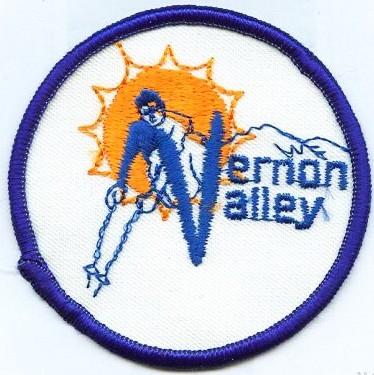
Some photos above and original VV patch at the top of the page are from the collection of Liz Holste, author of Skiing in New Jersey. Thanks Liz!
This site established February 2007 and is not complete. If you have photos of skiing, lifts, lodges, etc. at Vernon Valley pre-Intrawest, please consider contributing a scan of those photos. Hey...what good are they doing in your old photo albums? Likewise, if you have any memories or anecdotes you'd like to share with the skiing community from Vernon Valley days, please E-mail them to rick(at)skiernet(dot)com, and we will post them on this page.
Ski Into New Jersey History...
A friend of mine named Liz Holste has written a book about the history of skiing in New Jersey. That's right, Jersey. Liz contributed a lot of the photos and plenty of information for this webpage, so if you've read this far, you'll no doubt want to read her wonderful book. It has plenty more information about the Vernon area hills, as well as a surprising number of "lost" ski areas throughout the state. All over the state, in fact. Plenty of interesting stories and lots of photos, one of the most all-around fascinating ski books anywhere.
Here's an excerpt from the foreward, written by Donna Weinbrecht, 1992 Olympic Gold medalist: Liz takes you back in time to the birth of skiing in one of the most unlikely winter sports states in the country – New Jersey. Her book honors the spirit of the Europeans who brought their inbred passion for snow and the great outdoors to these shores. The spirit of these pioneers of skiing, described in this book is still alive in those of us who have been lucky enough to reap the rewards of their incredible journey.
To order the book, please click here. The link takes you to Amazon.com, so you know it's a safe place to order and whatnot. I'll print more info about the book when I have it, but really, if you're into history and skiing, it's a "must-have."
More Skiing History
Great Gorge • McAfee NJ Here's our page on VV's "sister" ski area, Great Gorge. We invite you to take the time machine back to mid station, Baker's Field, Aren'ts Delight...
Snow Bowl • Milton NJ Classic northeast ski area that went out of business circa 1974; if you don't mind a climb you can still ski it today.
Ski Dutchess • Beacon NY Fantastic 1,000' vertical overlooking the Hudson River. Closed in 1974.
NELSAP If you're interested in ski area history, you ought to know about NELSAP. This is the top site for information about "lost" ski areas, ski history, you name it. Bookmark it or memorize it.
Laurie's TeachSki Site Here's another "must-click" for ski history. Lots of photos, vintage postcards, something for everyone here. You'll click around this site for hours.
New England Ski Museum Located at Cannon Mountain, this is a "must-see" exhibit of skiing photos, equipment, lift stuff, you name it. A bona-fide museum, and a great source for skiing-oriented gifts. Good people.
SkierNet Host website for this Great Gorge webpage. Equipment guide, how-to, where-to...all-around resource for skiers.
Snowjournal Official message board for NELSAP, interesting & insightful community of skiers passionate about history and the northeast.
Original text and commentary copyright 2007 Rick Bolger, except for submitted material, which is copyright by the individual authors. Photos are either public domain or used by permission, in which case they are copyright of the rights owner. Any comments or submissions, please send to rick(at)skiernet(dot)com. Thanks. See you on Zero G's.